BrandRank.ai Normalization Transformation Rules Explained
Understanding brandrank.ai normalization transformation rules is becoming increasingly important for marketers, SEO professionals, data analysts, and businesses that rely on brand visibility measurement. As artificial intelligence driven ranking systems continue to evolve, the way raw data is standardized, transformed, and interpreted has a direct impact on the reliability of performance metrics.
The concept of brandrank.ai normalization transformation rules refers to the methods used to convert inconsistent, noisy, and diverse datasets into a structured format that can be accurately analyzed. Without normalization and transformation, data from different sources may produce misleading results, making comparisons difficult and reducing the value of brand intelligence platforms.
Organizations today collect information from search engines, social media channels, review platforms, news publications, customer feedback systems, and various digital touchpoints. Each source generates data in different formats. Some use percentages, others use raw counts, while some rely on categorical values. Bringing these sources together requires a well-defined normalization framework.
This article explores how normalization and transformation rules work, why they matter, the challenges involved, and how businesses can use them to improve decision-making and brand performance analysis.
What Are BrandRank.ai Normalization Transformation Rules?
At their core, normalization transformation rules are data processing guidelines designed to ensure consistency across datasets.
When information enters an analytics system, it often contains variations such as:
- Different naming conventions
- Inconsistent capitalization
- Duplicate records
- Missing values
- Diverse measurement scales
- Regional formatting differences
Normalization addresses these issues by standardizing data into a common structure.
Transformation goes a step further by modifying data into formats that are easier to analyze, compare, and interpret.
For example:
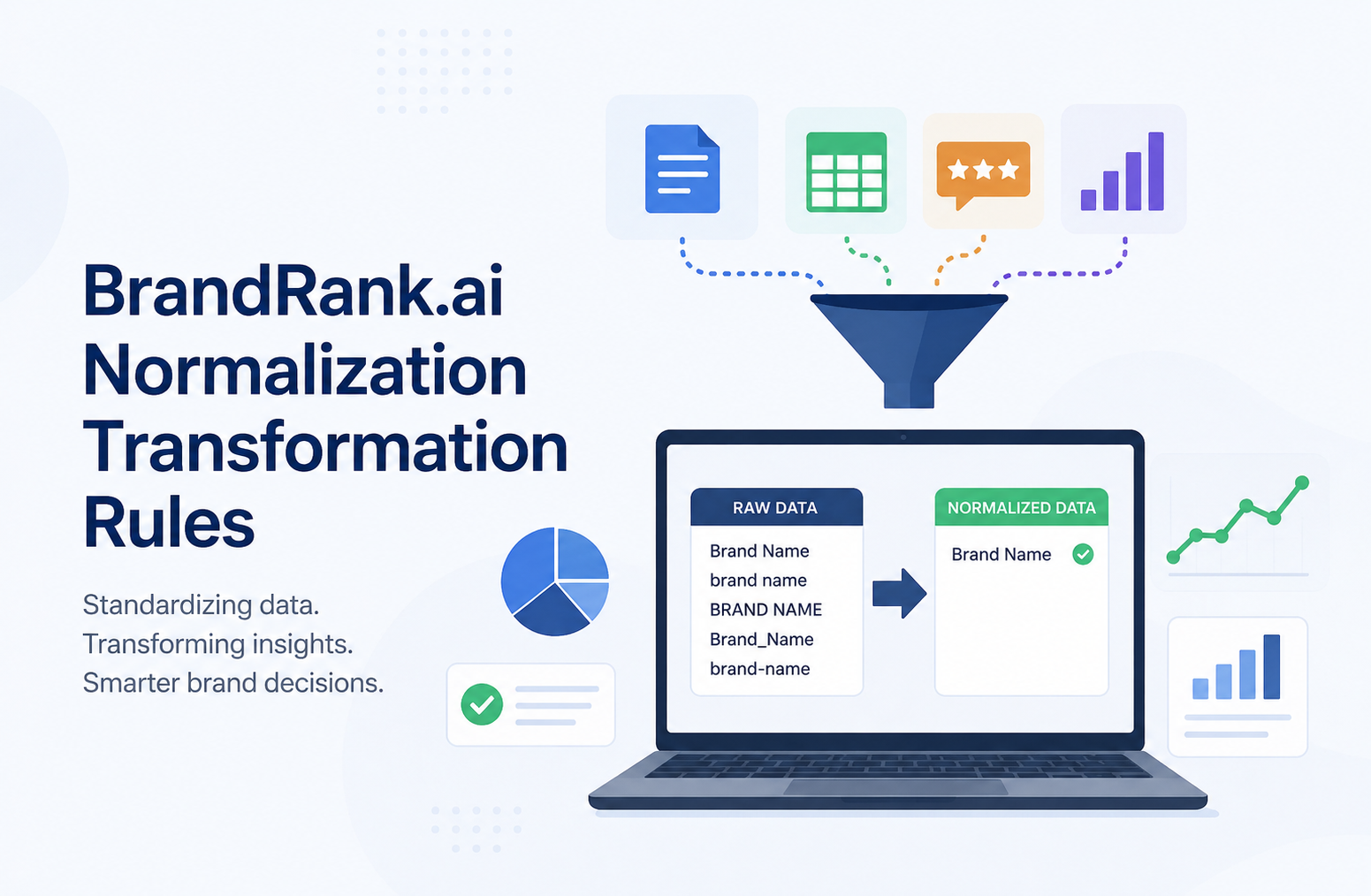
A platform may collect brand mentions from several channels.
One source records:
- Brand Name
Another records:
- brand name
A third records:
- BRAND NAME
Normalization rules identify these entries as the same entity and merge them into a unified format.
Similarly, transformation rules may convert numerical values into standardized scores, percentages, or weighted rankings that allow meaningful comparisons.
Why Normalization Matters in Brand Analytics
Many businesses assume that collecting large amounts of data automatically leads to better insights.
In reality, poor-quality data often produces poor-quality decisions.
Normalization helps solve several critical problems.
Eliminates Data Inconsistency
Data inconsistency is one of the biggest challenges in analytics.
When similar records are stored differently, reporting becomes unreliable.
Normalization creates a consistent foundation for analysis.
Improves Accuracy
Accurate reporting depends on clean data.
Without standardization, duplicate records and formatting differences can distort results.
Enhances Comparability
Businesses frequently compare performance across channels, campaigns, products, and markets.
Normalization ensures comparisons are based on equivalent metrics.
Supports AI Models
Artificial intelligence systems perform best when trained on structured and standardized information.
Clean datasets help algorithms identify meaningful patterns more effectively.
Enables Reliable Benchmarking
Organizations often benchmark their performance against competitors.
Standardized metrics create fair and trustworthy comparisons.
The Relationship Between Normalization and Data Transformation
Although often discussed together, normalization and transformation serve different purposes.
Normalization
Normalization focuses on standardizing information.
Examples include:
- Standardizing brand names
- Converting text formats
- Removing duplicate entries
- Standardizing date formats
- Unifying measurement units
Transformation
Transformation modifies data into a format suitable for analysis.
Examples include:
- Score scaling
- Category mapping
- Weight assignments
- Sentiment conversion
- Ranking calculations
Together, these processes create a reliable analytical framework.
Key Components of Data Normalization
Understanding the building blocks of normalization helps explain why these rules are so valuable.
Data Cleaning
The first stage involves identifying and correcting errors.
Common issues include:
- Typographical mistakes
- Incomplete records
- Invalid values
- Formatting inconsistencies
Clean data serves as the foundation for all subsequent analysis.
Duplicate Detection
Duplicate records can significantly inflate metrics.
Advanced systems use matching algorithms to identify duplicate entries even when slight variations exist.
Standardized Naming Conventions
Brand names, product names, and campaign identifiers often appear in multiple formats.
Standardization ensures every variation maps to a single recognized entity.
Format Consistency
Dates, currencies, percentages, and measurements may be stored differently across sources.
Normalization converts them into a unified format.
Missing Value Management
Datasets frequently contain gaps.
Rules determine how missing information should be handled, whether through estimation, replacement, or exclusion.
Common Transformation Techniques Used in Analytics
Transformation rules make data more meaningful and easier to compare.
Several techniques are commonly applied.
Min-Max Scaling
This technique converts values into a standardized range, often between 0 and 100.
It helps compare metrics that originally use different scales.
Log Transformation
Large numerical ranges can distort analysis.
Log transformation reduces extreme variations and improves distribution.
Weight-Based Scoring
Not all data points carry equal importance.
Transformation rules may assign weights based on relevance or business priorities.
Sentiment Transformation
Customer feedback often exists as text.
Transformation models convert qualitative opinions into measurable sentiment scores.
Category Mapping
Different sources may classify information differently.
Transformation aligns categories into a standardized structure.
How AI Benefits from Normalized Data
Artificial intelligence systems rely heavily on data quality.
Even advanced machine learning models struggle when fed inconsistent information.
Normalization supports AI by:
- Improving pattern recognition
- Reducing noise
- Increasing prediction accuracy
- Enhancing trend detection
- Supporting reliable ranking calculations
Many experts describe data quality as the most important factor influencing AI performance.
A widely cited principle from the field of data science is “garbage in, garbage out.”
The idea is simple.
If poor-quality data enters a system, poor-quality insights emerge regardless of algorithm sophistication.
Real-World Applications
Understanding practical applications helps clarify why these rules matter.
Brand Visibility Analysis
Organizations monitor brand presence across digital channels.
Normalization combines mentions from multiple sources into a unified reporting structure.
Reputation Management
Companies track customer sentiment from reviews, forums, and social platforms.
Transformation rules convert text-based feedback into measurable indicators.
Competitive Benchmarking
Businesses compare their market position against competitors.
Standardized metrics ensure fair comparisons.
Marketing Performance Evaluation
Campaign results often come from numerous platforms.
Normalization creates a consistent framework for evaluating effectiveness.
Executive Reporting
Leadership teams require concise and accurate reports.
Clean and transformed datasets improve reporting quality and decision-making.
Challenges in Implementing Normalization Rules
Despite the benefits, implementation is not always straightforward.
Data Volume
Modern organizations process enormous amounts of information.
Large datasets require scalable normalization systems.
Source Diversity
Every platform structures information differently.
Managing multiple formats can be complex.
Constant Data Changes
Data sources evolve over time.
Rules must adapt to changing structures and requirements.
Ambiguous Records
Some entries are difficult to classify correctly.
Advanced matching logic is often required.
Resource Requirements
Effective normalization demands expertise, technology, and ongoing maintenance.
Characteristics of Effective Transformation Rules
Not all transformation strategies deliver equal value.
The most effective approaches share several characteristics.
Consistency
Rules should produce the same result every time identical inputs are processed.
Transparency
Stakeholders should understand how scores and rankings are calculated.
Scalability
Systems must handle growing datasets efficiently.
Flexibility
Rules should adapt to evolving business needs.
Accuracy
The ultimate goal is generating reliable and meaningful insights.
Best Practices for Businesses
Organizations seeking stronger analytics capabilities can benefit from several proven practices.
Define Clear Data Standards
Establish standardized naming conventions, formats, and measurement rules.
Audit Data Regularly
Frequent audits help identify inconsistencies before they affect reporting.
Automate Where Possible
Automation reduces manual errors and improves efficiency.
Document Transformation Logic
Every transformation rule should be documented for transparency and governance.
Monitor Output Quality
Regular validation ensures processed data remains accurate.
Align Metrics with Business Goals
Transformation frameworks should support organizational objectives rather than simply processing data.
Understanding Scoring Systems
Many ranking platforms rely on scoring mechanisms.
These systems often combine multiple indicators into a single value.
Factors may include:
- Search visibility
- Brand mentions
- Engagement signals
- Authority indicators
- Sentiment measurements
- Competitive positioning
Normalization ensures each factor contributes fairly.
Transformation determines how factors are weighted and combined.
The result is a more meaningful representation of overall performance.
The Future of Data Normalization
As artificial intelligence becomes more sophisticated, normalization processes are expected to become increasingly automated.
Future developments may include:
- Real-time standardization
- Self-learning transformation models
- Improved entity recognition
- Advanced anomaly detection
- Automated quality assurance systems
Organizations that invest in structured data practices today will likely gain a competitive advantage as analytics technologies continue to evolve.
Frequently Asked Questions
What are brandrank.ai normalization transformation rules?
They are data processing guidelines used to standardize and transform information so it can be analyzed consistently and accurately across multiple sources.
Why is normalization important in analytics?
Normalization removes inconsistencies, improves data quality, and enables fair comparisons between datasets.
How does transformation differ from normalization?
Normalization standardizes data formats and structures, while transformation modifies data into analytical formats such as scores, categories, or rankings.
Can AI work without normalized data?
AI can process unstructured information, but performance, accuracy, and reliability generally improve significantly when data is normalized.
What industries benefit from normalization rules?
Marketing, finance, healthcare, retail, technology, and research organizations all benefit from standardized data processing.
Do normalization rules affect ranking accuracy?
Yes. Accurate normalization reduces bias and inconsistency, leading to more trustworthy rankings and insights.
Conclusion
Understanding brandrank.ai normalization transformation rules is essential for anyone working with modern analytics and brand intelligence systems. Data collected from multiple sources rarely arrives in a consistent format. Without proper normalization and transformation processes, organizations risk making decisions based on incomplete or misleading information.
Effective normalization creates consistency, while transformation converts raw information into meaningful metrics. Together, these processes improve reporting accuracy, support artificial intelligence systems, enhance benchmarking efforts, and strengthen strategic decision-making.
As digital ecosystems continue to generate larger and more complex datasets, the importance of structured data preparation will only increase. Businesses that prioritize data quality today will be better positioned to gain reliable insights, improve operational efficiency, and make smarter decisions in the future.