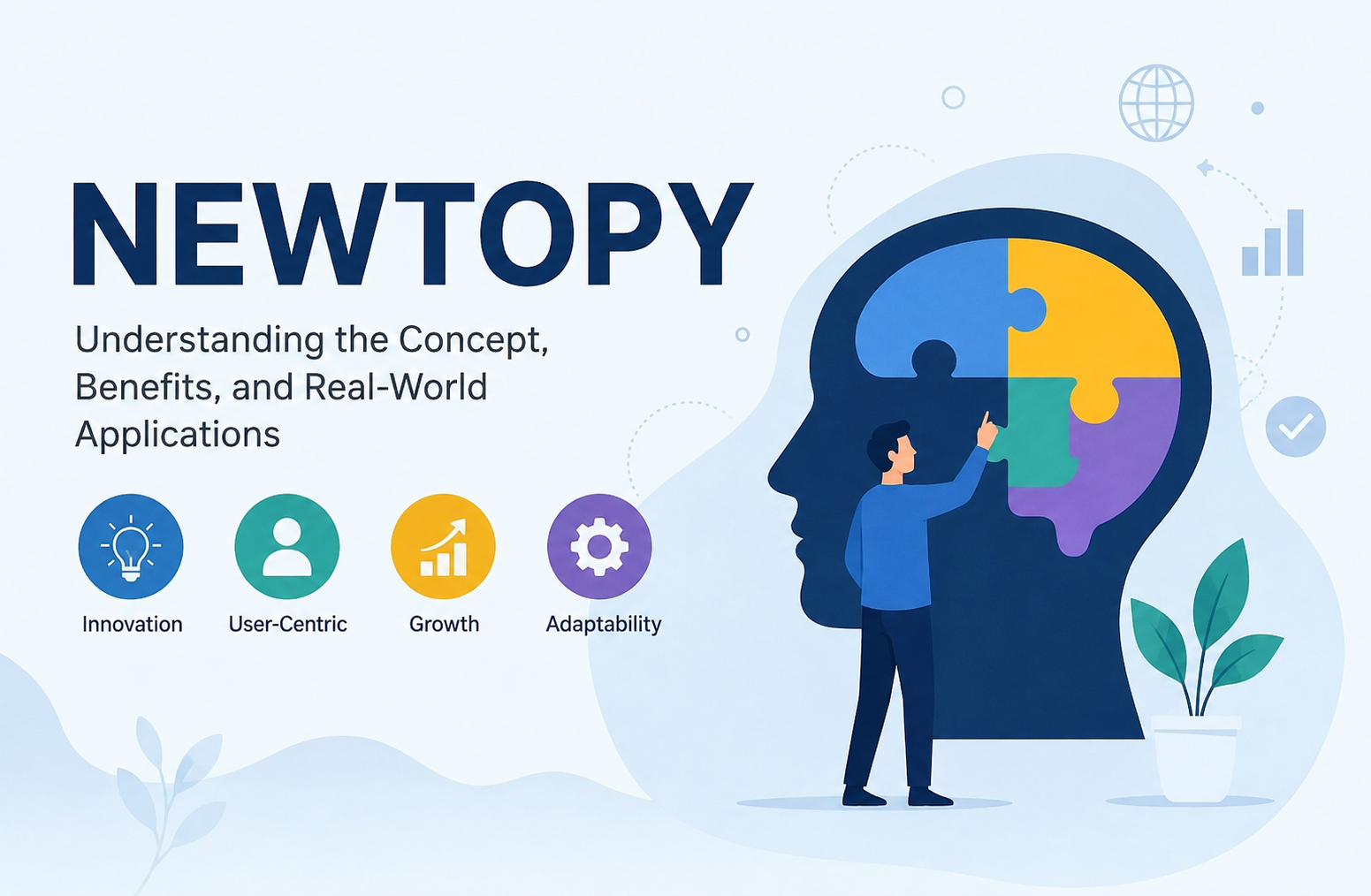
Newtopy: A Complete Guide to Understanding Its Impact
In today’s rapidly evolving digital and conceptual landscape, newtopy has emerged as a term that is gaining attention across multiple domains. Whether you’re a beginner trying to understand its meaning or someone looking to explore its deeper implications, this comprehensive guide will help you fully grasp what newtopy is, why it matters, and how it can be applied in real-world scenarios.
What Is Newtopy?
At its core, newtopy refers to a modern conceptual framework or emerging idea that reshapes how individuals, systems, or industries approach innovation, structure, or thinking patterns. While the exact definition can vary depending on context, it generally represents a shift from traditional methods toward more adaptive, forward-thinking approaches.
Unlike static concepts, newtopy is dynamic. It evolves with changing environments, technological advancements, and human behavior. This flexibility is what makes it both powerful and challenging to fully understand.
Key Characteristics of Newtopy
- Adaptability: It thrives in changing conditions
- Innovation-driven: Encourages new ways of thinking
- User-centric: Focuses on solving real problems
- Scalable: Applicable across industries and domains
Why Newtopy Matters Today
The growing relevance of newtopy can be attributed to the increasing complexity of modern challenges. Traditional systems often fail to address dynamic problems effectively. This is where newtopy offers a fresh perspective.
Real-World Relevance
From technology startups to education systems, newtopy is influencing decision-making and strategy development. For example:
- Businesses use it to improve customer experiences
- Educators apply it to modernize learning methods
- Creators leverage it to produce more engaging content
In my experience observing digital trends and working with evolving systems, approaches aligned with newtopy tend to outperform rigid frameworks. They allow room for experimentation while maintaining a clear direction.
Core Principles Behind Newtopy
Understanding newtopy requires breaking it down into its foundational principles. These principles guide its application and ensure it delivers meaningful outcomes.
1. Flexibility Over Rigidity
Traditional models often rely on fixed structures. Newtopy challenges this by promoting flexibility, allowing systems to evolve naturally.
2. Continuous Learning
Rather than aiming for perfection from the start, newtopy encourages iterative improvement. This aligns closely with real-world success patterns.
3. Human-Centered Thinking
One of the strongest aspects of newtopy is its focus on people. It prioritizes user needs, behaviors, and experiences.
4. Integration of Technology
Modern tools and technologies play a crucial role in enabling newtopy. However, technology is used as a means, not an end.
Benefits of Adopting Newtopy
When implemented correctly, newtopy offers a wide range of benefits. These advantages make it appealing across industries.
Improved Problem Solving
Newtopy allows for creative and unconventional solutions. Instead of following outdated methods, it opens the door to fresh ideas.
Increased Efficiency
By focusing on what truly matters, unnecessary processes are eliminated. This leads to faster and more effective outcomes.
Better User Engagement
Since newtopy emphasizes user experience, it naturally leads to higher engagement and satisfaction.
Future-Readiness
Organizations and individuals who adopt newtopy are better prepared for future changes. They can adapt quickly without major disruptions.
Challenges and Limitations
Despite its benefits, newtopy is not without challenges. Understanding these limitations is essential for successful implementation.
Lack of Clear Definition
Because newtopy is still evolving, it can sometimes be difficult to define or standardize. This can lead to confusion.
Resistance to Change
People and organizations often resist new ideas. Transitioning to newtopy requires a mindset shift, which can take time.
Implementation Complexity
Applying newtopy effectively requires careful planning and understanding. Without proper execution, results may fall short.
Risk of Misinterpretation
Some may adopt the concept superficially without fully understanding its principles. This can lead to ineffective outcomes.
Real-World Applications of Newtopy
The versatility of newtopy makes it applicable in various fields. Let’s explore how it is being used in practice.
Business and Entrepreneurship
Companies are using newtopy to:
- Develop innovative products
- Enhance customer experiences
- Build agile teams
Startups, in particular, benefit from its flexibility, allowing them to pivot quickly based on market feedback.
Education
Educational institutions are incorporating newtopy by:
- Adopting interactive learning methods
- Encouraging critical thinking
- Integrating digital tools
This approach prepares students for real-world challenges rather than just theoretical knowledge.
Technology and Innovation
In the tech world, newtopy drives:
- Product development cycles
- User interface design
- Artificial intelligence advancements
Developers and designers use it to create more intuitive and efficient systems.
Content Creation
Creators are leveraging newtopy to:
- Produce audience-focused content
- Experiment with new formats
- Build stronger connections with their audience
This results in more engaging and impactful content.
How to Implement Newtopy Effectively
Adopting newtopy requires more than just understanding the concept. It involves practical steps and consistent effort.
Step 1: Understand Your Goals
Before applying newtopy, clearly define what you want to achieve. This ensures alignment with your objectives.
Step 2: Analyze Current Systems
Evaluate your existing processes. Identify areas that need improvement or innovation.
Step 3: Encourage Open Thinking
Create an environment where ideas are welcomed. Innovation thrives in open and collaborative spaces.
Step 4: Start Small
Begin with small changes. Test and refine your approach before scaling.
Step 5: Measure Results
Track your progress and analyze outcomes. This helps in making informed decisions.
Step 6: Adapt Continuously
Newtopy is not a one-time implementation. It requires ongoing adjustment and improvement.
Common Mistakes to Avoid
When working with newtopy, certain mistakes can hinder success. Being aware of these can save time and effort.
- Overcomplicating the process
- Ignoring user needs
- Lack of clear direction
- Failure to adapt based on feedback
- Assuming instant results
From practical observation, one of the biggest mistakes is expecting immediate transformation. Newtopy works best when given time to evolve.
Newtopy vs Traditional Approaches
To better understand newtopy, it helps to compare it with traditional methods.
| Aspect | Traditional Approach | Newtopy Approach |
| Structure | Fixed | Flexible |
| Innovation | Limited | High |
| Focus | Process-driven | User-driven |
| Adaptability | Low | High |
| Growth | Linear | Dynamic |
This comparison highlights why many are shifting toward newtopy-based strategies.
The Future of Newtopy
As industries continue to evolve, the importance of newtopy is expected to grow. Its emphasis on adaptability and innovation aligns perfectly with future trends.
Emerging Trends
- Increased integration with AI and automation
- Greater focus on personalization
- Expansion into new industries
- Enhanced collaboration across global teams
While it is difficult to predict exact outcomes, the trajectory suggests that newtopy will play a significant role in shaping future systems.
Expert Insights and Observations
Based on current trends and practical experiences, newtopy is not just a temporary concept. It represents a deeper shift in how we approach challenges and opportunities.
Experts often emphasize the importance of mindset when adopting newtopy. Tools and strategies are important, but the real transformation happens at the thinking level.
In many cases, success comes from:
- Embracing uncertainty
- Being open to change
- Focusing on continuous improvement
Frequently Asked Questions (FAQs)
What does newtopy mean in simple terms?
Newtopy refers to a modern approach that focuses on innovation, adaptability, and user-centered thinking.
Is newtopy applicable to all industries?
Yes, it can be adapted to various fields including business, education, technology, and content creation.
How long does it take to see results?
Results vary depending on implementation, but it typically requires consistent effort and gradual improvement.
Is newtopy difficult to implement?
It can be challenging initially, especially due to mindset shifts, but becomes easier with practice.
Can individuals use newtopy or is it only for organizations?
Both individuals and organizations can benefit from applying newtopy principles.
What is the biggest advantage of newtopy?
Its ability to adapt to changing environments while maintaining a focus on real user needs.
Conclusion
Newtopy represents a powerful shift in how we think, create, and solve problems. By focusing on adaptability, innovation, and user needs, it provides a framework that is both practical and forward-looking. While challenges exist, the benefits far outweigh the limitations when applied correctly.
Understanding and implementing newtopy is not about following a rigid formula. It is about embracing a mindset that values growth, flexibility, and continuous improvement. As the world continues to change, approaches like newtopy will become increasingly essential for long-term success.