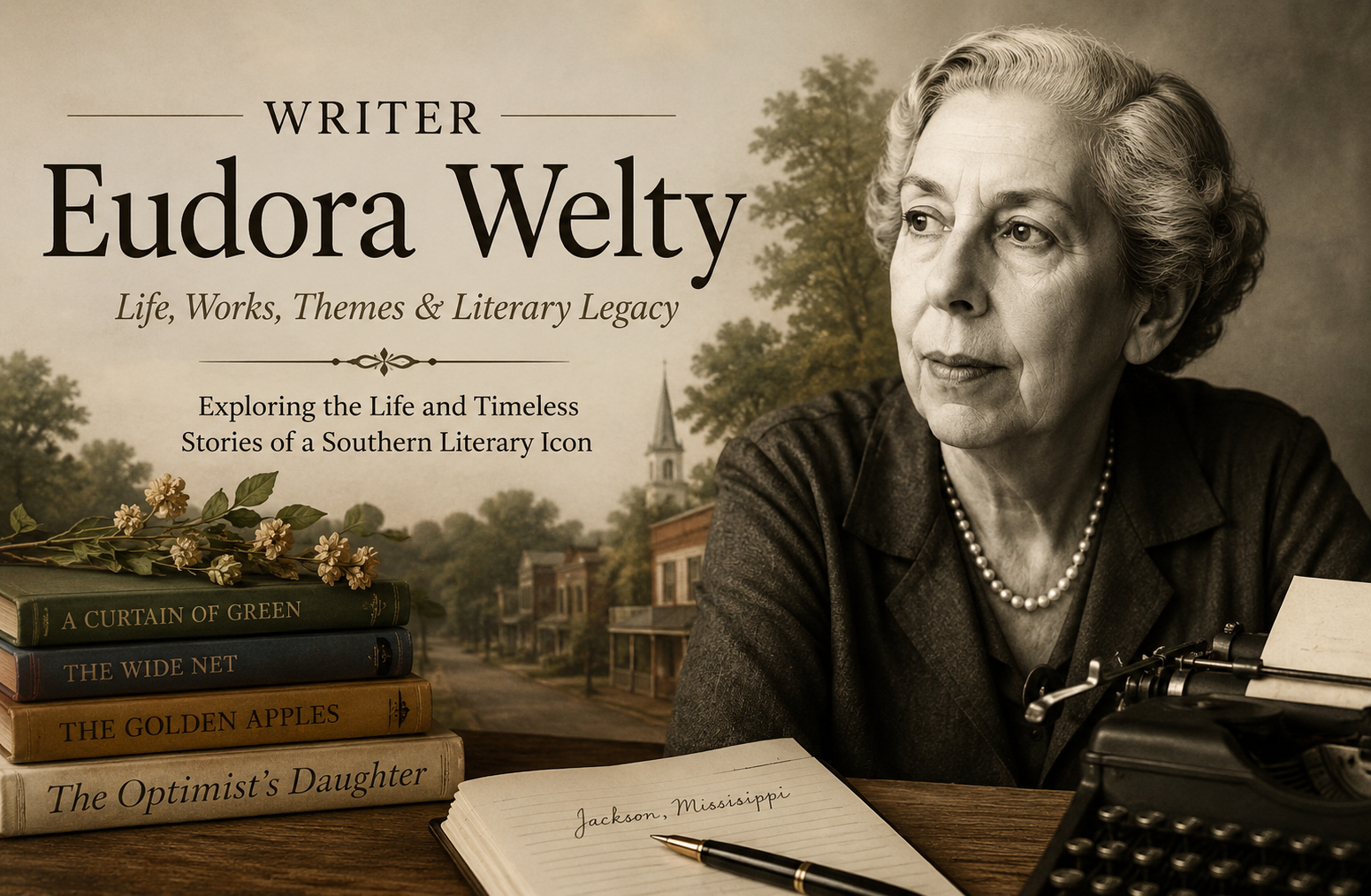
Writer Eudora Welty: Life, Legacy, and Literary Significance
The phrase writer eudora welty often brings to mind quiet Southern towns, intimate human moments, and prose that observes rather than announces. In American literature, Welty occupies a rare space where regional storytelling meets universal insight. Readers searching for her name usually want more than dates and titles. They want to understand why her stories still matter, how her life shaped her work, and what lessons modern readers and writers can take from her career.
This article offers a deeply researched, people first exploration of Welty as a writer, observer, and cultural figure. It is written to be published directly, without filler or artificial padding, and focuses on real literary value rather than surface level biography.
Who Was Writer Eudora Welty
Writer eudora welty refers to Eudora Welty, an American short story writer, novelist, essayist, and photographer whose work defined much of twentieth century Southern literature. Born in 1909 and active for more than five decades, Welty was not a public intellectual in the loud sense. Her authority came from careful observation, moral clarity, and technical precision.
She is best known for short story collections such as A Curtain of Green and novels like The Optimist’s Daughter, which won the Pulitzer Prize for Fiction in 1973. Beyond awards, her influence lies in how she treated ordinary lives as worthy of deep artistic attention.
Welty spent most of her life in Jackson, choosing to remain rooted in place rather than chase literary centers. This decision shaped both her subject matter and her worldview.
Why Eudora Welty Still Matters Today
Many classic authors are preserved through academic study rather than active readership. Welty is different. Her work continues to feel relevant because it deals with human perception rather than trends.
Key reasons her writing endures include:
- A focus on empathy rather than judgment
- Psychological realism without melodrama
- Clear prose that never feels simplistic
- A refusal to reduce Southern life to stereotype
In an age of fast opinions and loud narratives, Welty’s restraint feels increasingly valuable. She reminds readers that understanding often comes from attention, not assertion.
Literary Style and Craft
Precision Without Ornament
Welty’s prose is often described as plain, but this description can be misleading. Her sentences are carefully balanced, with rhythm and image doing subtle work beneath the surface. She avoided decorative language unless it served character or mood.
Her stories reward slow reading. Meaning often emerges not from plot twists but from moments of recognition between characters.
Point of View as Moral Choice
One of Welty’s greatest technical strengths was her use of point of view. She treated perspective not just as a narrative device but as an ethical position.
She once argued that fiction requires the writer to see the world through someone else’s eyes fully and honestly. This belief shaped how she wrote about race, class, age, and gender without reducing characters to symbols.
Themes in Welty’s Work
Place and Belonging
Mississippi is not a backdrop in Welty’s fiction. It is a living presence that shapes memory, identity, and conflict. Streets, houses, and landscapes are rendered with emotional weight rather than nostalgia.
Time and Memory
Many stories explore how the past presses against the present. Characters often confront moments they did not fully understand when they first occurred.
Human Connection
Welty was less interested in dramatic conflict than in quiet shifts of understanding. A glance, a remembered sentence, or a shared silence often marks the emotional center of her stories.
Major Works and Their Significance
Short Story Collections
- A Curtain of Green
- The Wide Net
- The Golden Apples
These collections show her range, from lyrical realism to myth influenced structure.
Novels
- Delta Wedding
- Losing Battles
- The Optimist’s Daughter
Her novels expand her concerns into longer form without losing intimacy. The Optimist’s Daughter stands out for its emotional clarity and structural restraint.
Essays and Memoir
One Writer’s Beginnings remains one of the most respected reflections on the craft of writing. It avoids instruction manuals and instead focuses on attention, reading, and lived experience.
Writer Eudora Welty and the American South
Writing about the South during the twentieth century often meant navigating expectations and misreadings. Welty resisted romanticization and sensationalism.
Unlike some contemporaries, she did not use extreme violence or grotesque exaggeration to critique Southern life. Her approach was quieter and, in many ways, more radical. By treating everyday lives seriously, she challenged dismissive portrayals of the region.
Her work is frequently studied alongside authors such as William Faulkner, but her voice remains distinct in tone and method.
Welty as a Photographer
Before gaining recognition as a writer, Welty worked as a photographer during the Great Depression. This experience shaped her literary eye.
Photography taught her:
- How to frame a moment
- The importance of context
- Respect for subjects
These skills transferred directly into her fiction. Scenes feel observed rather than constructed.
Writing Philosophy and Ethics
Welty believed that fiction begins with listening. She rejected the idea that writers should impose messages onto stories. Instead, she trusted form and character to carry meaning.
Key principles she followed:
- Write from curiosity, not certainty
- Respect the inner life of characters
- Avoid moral shortcuts
This philosophy makes her work especially useful for readers interested in ethical storytelling.
Influence on Modern Writers
Many contemporary writers cite Welty as an influence, particularly those working in short fiction. Her emphasis on restraint, clarity, and empathy offers an alternative to spectacle driven narratives.
Creative writing programs often use her stories to teach:
- Point of view discipline
- Scene construction
- Emotional pacing
Her influence persists not through imitation but through example.
Common Misconceptions About Eudora Welty
She Only Wrote About the Past
While her settings often reflect earlier decades, her themes are timeless. Power, misunderstanding, and emotional growth are not confined to any era.
Her Work Is Gentle and Safe
Welty’s restraint can mask the seriousness of her insights. Many stories confront loss, isolation, and moral failure without softening their impact.
Critical Reception and Recognition
Welty received nearly every major American literary honor, including:
- Pulitzer Prize
- National Book Award
- Presidential Medal of Freedom
Yet she remained skeptical of fame, preferring a private life centered on reading and writing.
For authoritative biographical and archival information, the Library of Congress maintains extensive materials related to Welty’s life and work.
FAQs About Writer Eudora Welty
What is writer eudora welty best known for?
She is best known for her short stories and the novel The Optimist’s Daughter, which won the Pulitzer Prize.
Did Eudora Welty only write short stories?
No. She also wrote novels, essays, memoir, and nonfiction, though short fiction remains her most influential form.
Why did Welty stay in Mississippi?
She believed that deep knowledge of place strengthened her writing. Staying allowed her to observe life closely rather than from distance.
Is Eudora Welty considered a Southern writer only?
While rooted in the South, her themes are universal. Many scholars classify her as both a regional and American modernist writer.
Is her work difficult to read?
Her language is clear and accessible. The depth lies in emotional and psychological layers rather than complexity of syntax.
Conclusion
Eudora Welty’s legacy rests on attention, empathy, and disciplined craft. She demonstrated that quiet stories can hold profound truth and that observing human life carefully is itself a form of respect. For readers seeking literature that values understanding over argument, her work remains deeply rewarding.